
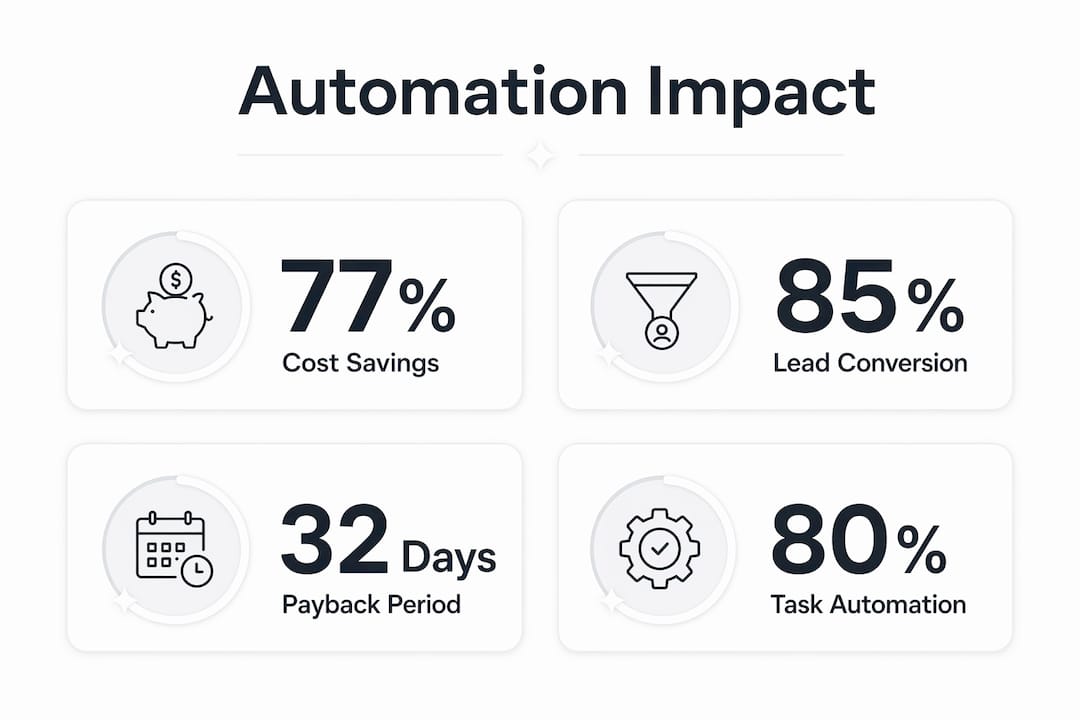
Property management automation is defined as the use of AI-driven software and workflow tools to replace manual, repetitive operational tasks with technology-executed processes that improve efficiency, accuracy, and tenant engagement. The role of automation in property management has shifted from a competitive advantage to an operational baseline. Platforms like AppFolio Realm-X, Buildium, and Frontdesk now handle leasing intake, maintenance triage, rent collection, and multi-channel tenant communication at scale. According to 2026 Frontdesk research, 94% of multifamily operators are implementing or planning AI solutions, reporting 77% reduced operating expenses and 85% increased lead-to-lease conversion. That data point signals a market-wide inflection, not a trend.
What operational tasks in property management benefit most from automation?
The automation benefits in property management are most pronounced in tasks that are high-volume, rule-based, and time-sensitive. Identifying those tasks first is the fastest path to measurable ROI. The following categories represent where property managers consistently capture the greatest gains.
-
Leasing intake and tour booking. AI scheduling tools like Frontdesk handle inbound inquiries, qualify prospects, and book self-guided or agent-led tours without staff involvement. This compresses lead response time dramatically, and over 90% faster lead response times are now documented across automated leasing workflows.
-
Tenant screening and lease management. Automated screening platforms pull credit, criminal, and eviction data, then generate compliance-ready documentation and audit trails that support adverse action decisions under local law. This removes both delay and legal exposure from the process.
-
Maintenance request triage. Residents submit requests through a portal or SMS, and the system categorizes urgency, routes to the correct vendor, and sends status updates without a coordinator touching the ticket. This alone reduces inbound maintenance calls significantly.
-
Rent collection and delinquency outreach. Automated payment reminders, late notices, and escalation sequences run on schedule without manual follow-up. Eviction cost avoidance is one of the clearest financial returns from this workflow.
-
Lease renewal campaigns. Renewal nurture sequences start 90 to 120 days before expiration, sending personalized offers and tracking responses. Automation in this area directly supports the 3% to 7% renewal rate improvement reported in 2026 market data.
Pro Tip: Before selecting any automation tool, map every task your team performs in a week and flag anything done more than three times with the same steps. Those are your highest-priority automation candidates, and they will produce the fastest payback.
How does automation improve tenant communication and engagement?

Tenant communication is where automation delivers the most visible and measurable impact on satisfaction. Faster maintenance responses and transparent communication are the two factors renters rank highest when evaluating their property management experience. Automation addresses both directly.
Multi-channel messaging is the foundation. Effective platforms route messages across email, SMS, push notifications, and tenant portal alerts, then confirm delivery at each channel. A 2026 case study on a 400-unit portfolio found that automated multi-channel communication raised confirmed tenant delivery from 61% to 100% within 90 days, generating an 11.4x ROI and a 32-day payback period. That result is not an outlier. It reflects what happens when delivery confirmation and traceability are built into the workflow from day one.
The communication benefits extend across the full tenant lifecycle:
- Emergency notifications reach all residents simultaneously with confirmed receipt, eliminating the risk of missed alerts during maintenance shutdowns or safety events.
- Maintenance status updates are sent automatically at each workflow stage, reducing inbound "where is my technician?" calls by a measurable margin.
- Lease renewal reminders and move-out instructions arrive on schedule without coordinator involvement, keeping residents informed and reducing friction at critical decision points.
- SMS opt-in rates and tenant portal adoption both increase when residents experience consistent, timely communication, which compounds engagement over time.
Pro Tip: Set up delivery confirmation tracking from the start of any communication automation deployment. Without traceability data, you cannot identify which channel is underperforming or prove compliance with notice requirements.
| Communication channel | Primary use case | Key benefit |
|---|---|---|
| SMS | Urgent alerts, payment reminders | Highest open rate, fastest response |
| Lease documents, renewal offers | Audit trail, attachment support | |
| Tenant portal | Maintenance requests, statements | Self-service, 24/7 access |
| Push notifications | Emergency broadcasts | Confirmed delivery at scale |
What challenges should property managers avoid when implementing automation?
The impact of automation on property management is only as strong as the integration architecture supporting it. The most common failure mode is not choosing the wrong tool. It is deploying automation within a single system while leaving adjacent workflows on manual processes, which creates gaps that undermine the entire operation.
Technology implementation is now a top challenge for real estate leaders, according to 2025 NAA and AppFolio research. With 53% of professionals using general-purpose AI tools and 43% using AI embedded in their property management system, data fragmentation across platforms is the norm, not the exception. When tenant records, maintenance logs, and financial data live in separate systems without synchronized triggers, automation produces partial results at best.
A second pitfall is data quality. Automated workflows depend entirely on accurate tenant contact information. An SMS campaign with 20% invalid numbers does not just underperform. It creates compliance exposure if notice delivery cannot be confirmed. Auditing and cleaning contact data before deployment is not optional. It is a prerequisite.
Automation governance is the third area where property managers frequently underinvest. Every workflow needs a defined boundary: what the system handles automatically, and what requires human review. Financial decisions, adverse action notices, and compliance-sensitive communications should always include a human checkpoint, regardless of how confident the AI model appears. Overreliance on native automations within a single PMS, without cross-system orchestration, is the specific failure pattern that 2026 industry analysis flags most frequently.
Pro Tip: Build your automation governance document before you go live. List every workflow, define the trigger, the action, and the human review point. This document becomes your compliance record and your troubleshooting guide simultaneously.
How does automation impact operational efficiency and financial performance?
The financial case for property management automation tools is now backed by enough real-world data to move beyond projection. The numbers from 2026 deployments are specific and repeatable across portfolio sizes.
Automation reduces leasing and maintenance staff communication time by over 80%, according to US Tech Automations case data. That time does not disappear from the organization. It gets reallocated to relationship management, vendor oversight, and portfolio growth activities that require human judgment. The Buildium research perspective reinforces this: AI handles volume tasks while human agents focus on high-value decisions, which is a structural shift in how property management teams are organized rather than a headcount reduction.
"Automation in property management is not about replacing people. It is about removing the work that prevents people from doing their best work." This framing, supported by 2026 NARPM staffing data, explains why firms that deploy automation thoughtfully report higher staff retention alongside lower operating costs.
The efficiency gains translate directly to financial performance across three measurable dimensions:
| Metric | Reported impact | Source context |
|---|---|---|
| Operating expense reduction | 77% | Frontdesk 2026 multifamily survey |
| Lead-to-lease conversion increase | 85% | Frontdesk 2026 multifamily survey |
| Lease renewal rate improvement | 3% to 7% | 2026 agentic AI market reporting |
| Incident workflow time savings | 30%+ | McKinsey-related 2026 agentic AI data |
| Tenant delivery confirmation | 61% to 100% in 90 days | US Tech Automations 400-unit case study |
The payback period on communication automation specifically is short. The 400-unit portfolio case study recorded a 32-day payback, which means the investment recovered itself before the first quarterly review. At that speed, the question for property managers is not whether to automate. It is which workflows to prioritize first.
What are the emerging technologies shaping property management automation?
The next generation of property management automation tools moves well beyond chatbots and scheduled email sequences. Agentic AI is the defining shift. These systems execute multi-step workflows autonomously, making conditional decisions across integrated data sources without waiting for human input at each stage. A leasing agent AI, for example, does not just answer questions. It qualifies the prospect, checks unit availability, schedules the tour, sends the application link, and follows up on incomplete submissions, all within a single conversation thread.
PMS-agnostic AI layers
PMS-agnostic front-office AI platforms that operate across voice, SMS, and outbound campaigns outperform native PMS chatbots in both adoption rates and measurable impact. This matters because most mid-market operators run more than one property management system across their portfolio. A front-office AI layer that connects to Yardi, RealPage, and Entrata simultaneously consolidates tenant interactions into a single workflow without requiring platform migration.
Voice-first resident engagement
Resident preferences are shifting toward voice interaction. Smart speaker integration and inbound call AI are growing adoption channels, particularly among residents who prefer phone contact over portal navigation. Property management firms that deploy voice-capable AI handle after-hours calls, emergency triage, and maintenance intake without staffing a call center overnight.
Multi-PMS data consolidation
Consolidating data into a single platform is the infrastructure requirement that makes performance management possible at scale. When leasing, maintenance, financial, and communication data feed into one analytics layer, portfolio managers can identify underperforming assets, predict renewal risk, and allocate resources based on real signals rather than lagging reports.
Human trust and adoption remain the largest barrier to realizing AI's value in this space. The technology is ready. The organizational readiness to trust and govern it is where most firms are still catching up.
Key takeaways
Automation in property management delivers measurable ROI only when deployed across integrated systems with clear governance, accurate data, and defined human review points.
| Point | Details |
|---|---|
| Automation scope | Prioritize leasing intake, maintenance triage, and rent collection for the fastest payback. |
| Communication ROI | Multi-channel delivery confirmation drove 11.4x ROI in a documented 90-day deployment. |
| Integration architecture | Cross-system triggers and data mapping must be designed before go-live to avoid partial automation. |
| Governance requirement | Define human review checkpoints for financial, compliance, and adverse action workflows before deployment. |
| Emerging technology | Agentic AI and PMS-agnostic voice layers are the next operational frontier for mid-market operators. |
Why automation strategy matters more than automation tools
After reviewing dozens of property management automation deployments, the pattern that separates high-ROI implementations from expensive experiments is not the software selected. It is the clarity of the operational strategy before any tool is purchased.
Property managers who start with a workflow audit, identify their highest-volume repetitive tasks, and define governance rules before evaluating platforms consistently outperform those who buy a tool and then figure out how to use it. The technology in this space, from AppFolio Realm-X to Frontdesk to Buildium, is genuinely capable. The limiting factor is almost always organizational, not technical.
The staff reallocation point deserves more attention than it typically receives. When automation removes 80% of routine communication tasks from a leasing coordinator's day, that person does not become redundant. They become available for the relationship-intensive work that actually drives renewals and referrals. Firms that frame automation as infrastructure for their people, rather than a replacement for them, see higher adoption rates and better long-term outcomes.
Data quality is the unglamorous prerequisite that determines whether any of this works. A workflow built on incomplete tenant contact records produces incomplete results. Investing in a contact data audit before deployment is not overhead. It is the foundation the entire system runs on.
The firms winning with automation in 2026 are not the ones with the most tools. They are the ones with the clearest picture of what they are automating, why, and where a human still needs to be in the loop.
— Dustin
Explore property management analytics and automation tools
Property managers ready to move from manual workflows to data-driven operations need more than a single tool. They need a structured view of the technology options available and the performance data to evaluate them objectively.
Insideiris provides exactly that. The platform's real estate data analytics terminal gives mid-market operators and real estate professionals access to structured technology indexes, performance benchmarks, and market intelligence across property management automation platforms. Rather than sorting through generic software reviews, Insideiris routes decision-makers directly to the tools and data sources that match their operational profile. For firms evaluating how automation fits their current tech stack, the Insideiris real estate technology directory is a practical starting point.
FAQ
What is the role of automation in property management?
Automation in property management replaces manual, repetitive operational tasks with AI-driven workflows covering leasing, maintenance, rent collection, and tenant communication. The goal is to increase efficiency, reduce operating costs, and improve tenant satisfaction at scale.
How does automation improve property management financial performance?
Documented results from 2026 deployments include 77% reduced operating expenses, 85% increased lead-to-lease conversion, and lease renewal rate improvements of 3% to 7%. A 400-unit portfolio case study recorded a 32-day payback period on communication automation alone.
What are the most common pitfalls when implementing property management automation?
The most frequent failures are deploying automation within a single system without cross-platform integration, using incomplete tenant contact data, and failing to define governance rules for human review on financial and compliance workflows.
Which property management tasks should be automated first?
Leasing intake, maintenance request triage, rent collection reminders, and lease renewal campaigns offer the highest volume and most consistent ROI. These tasks are rule-based, high-frequency, and directly tied to tenant satisfaction and revenue retention.
What is agentic AI and how does it apply to property management?
Agentic AI executes multi-step workflows autonomously across integrated systems, handling prospect qualification, tour scheduling, application follow-up, and maintenance routing without requiring human input at each stage. It represents the next operational layer beyond basic chatbot and scheduled messaging tools.